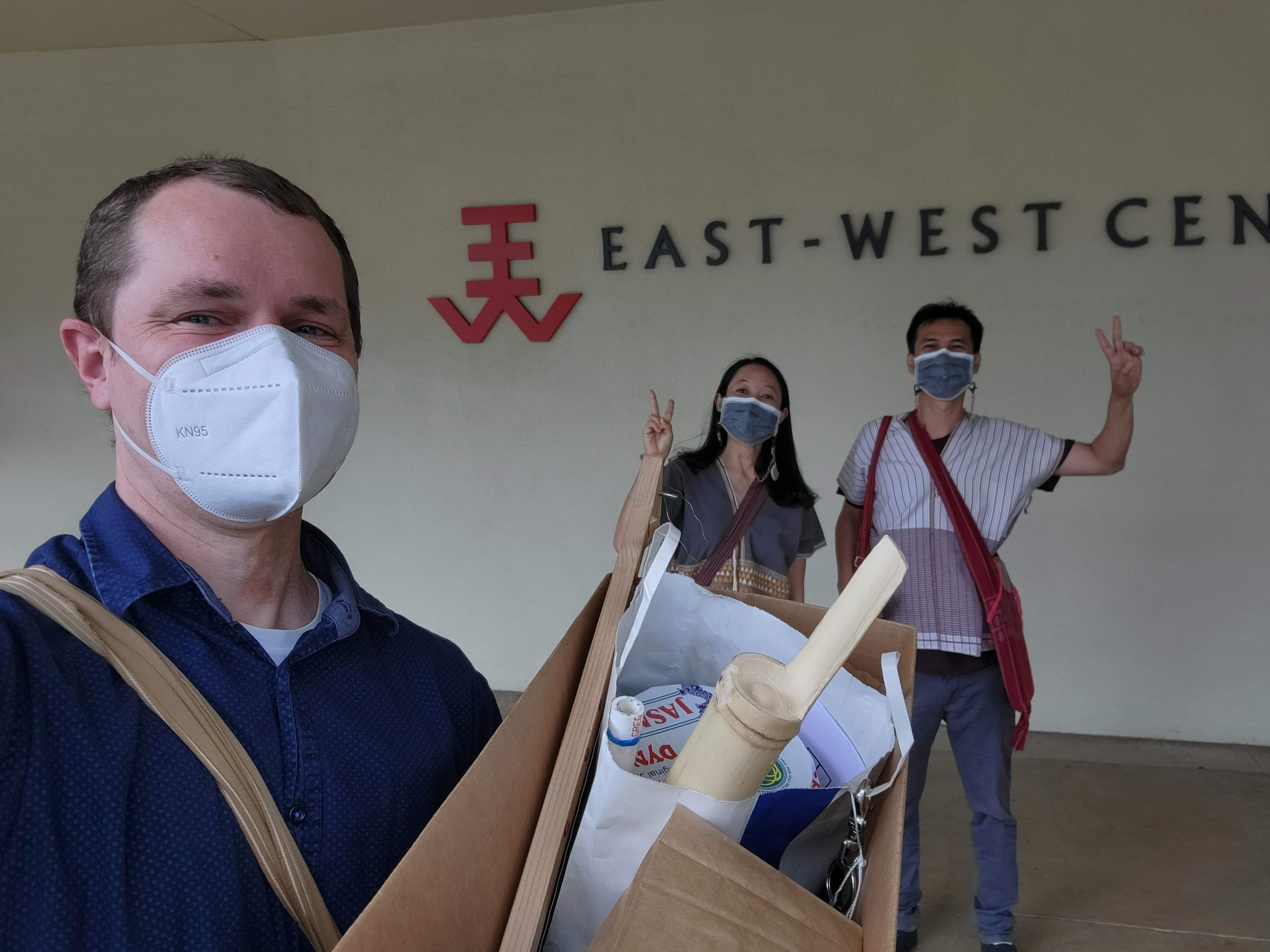
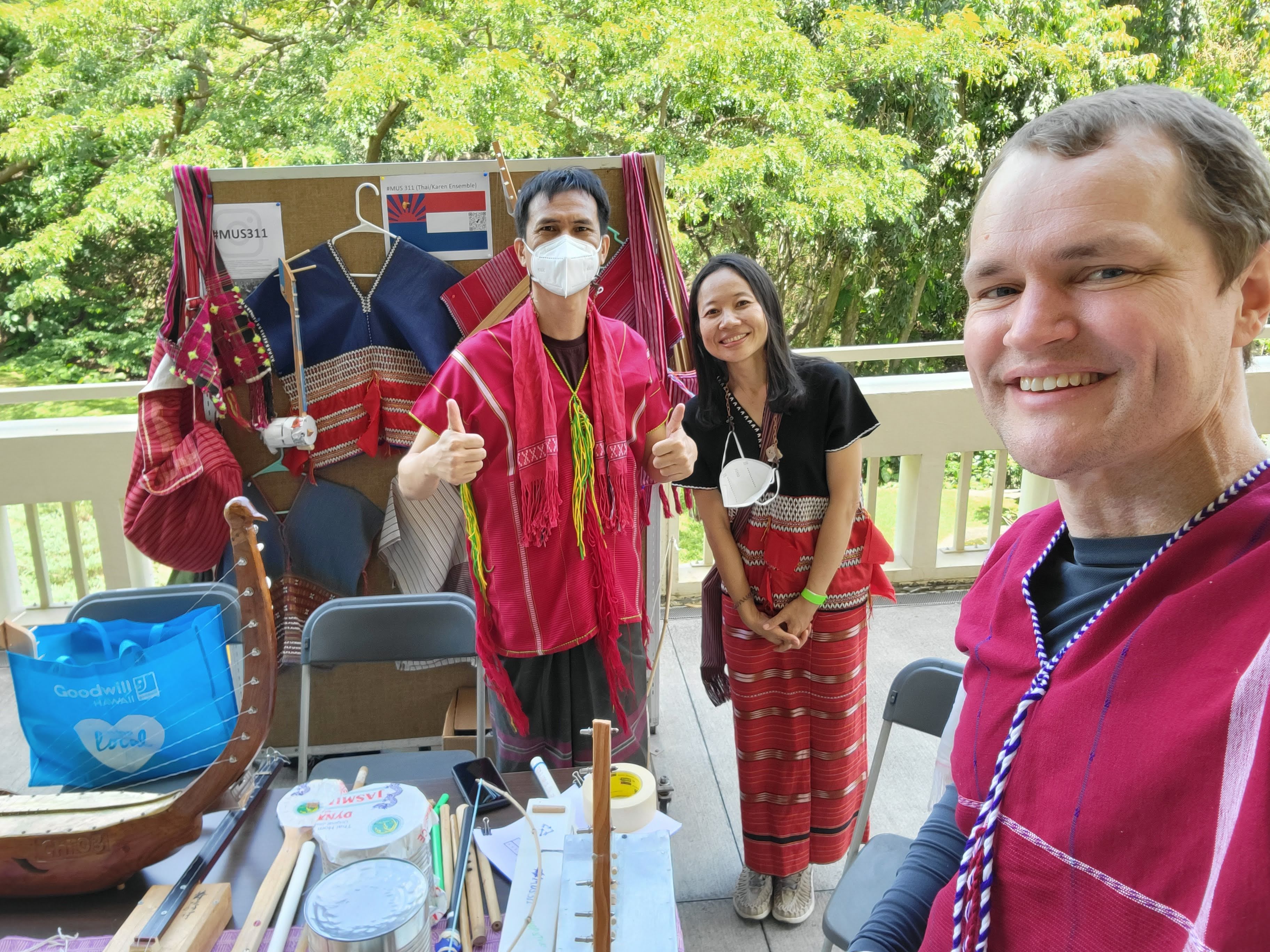
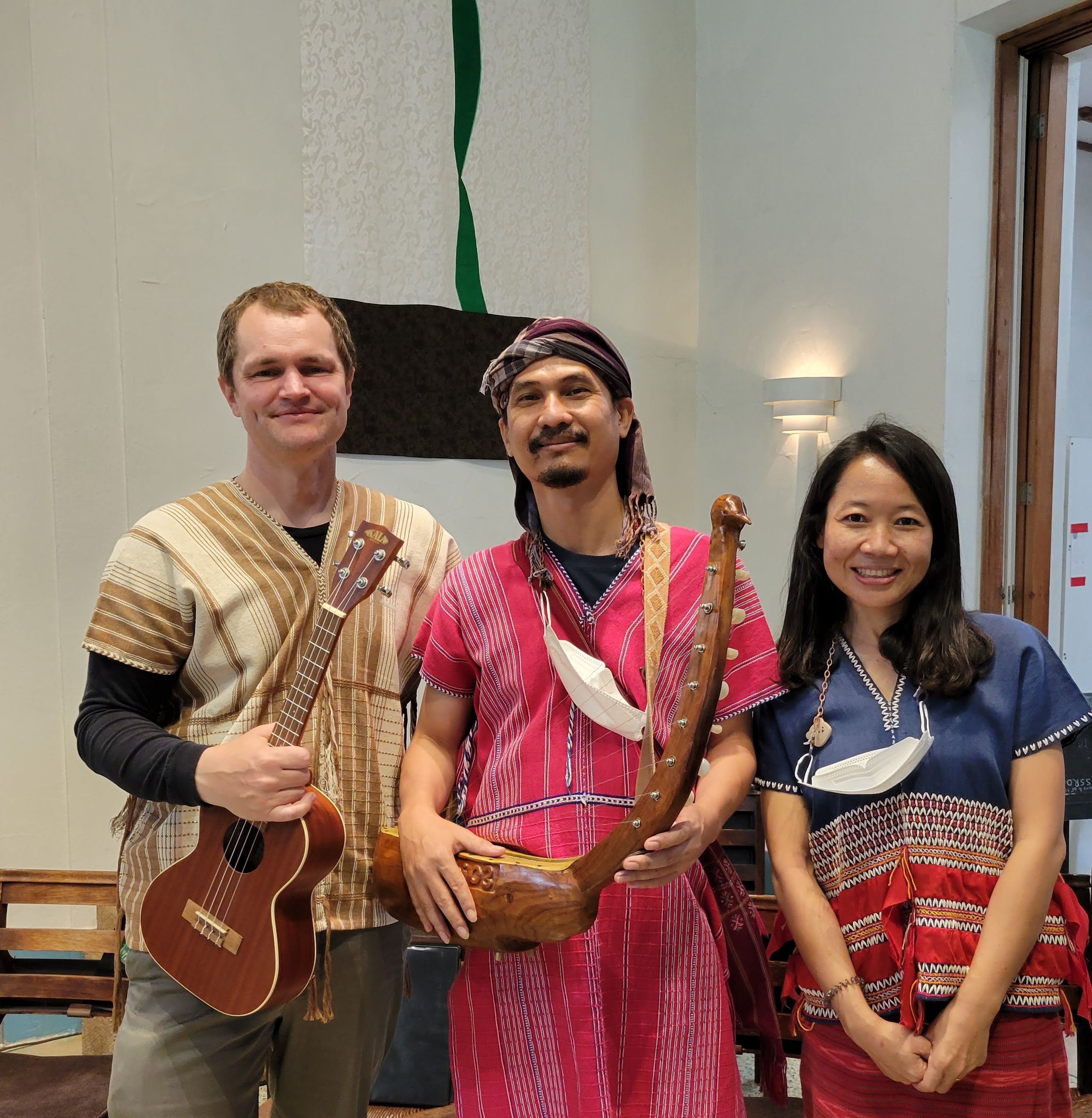
Since 2012 I have been working with Dr. Chi Suwichan Phatthanaphraiwan on various projects and publications related to music of the indigenous Pgaz k’Nyau (Karen) people of Thailand & Myanmar.
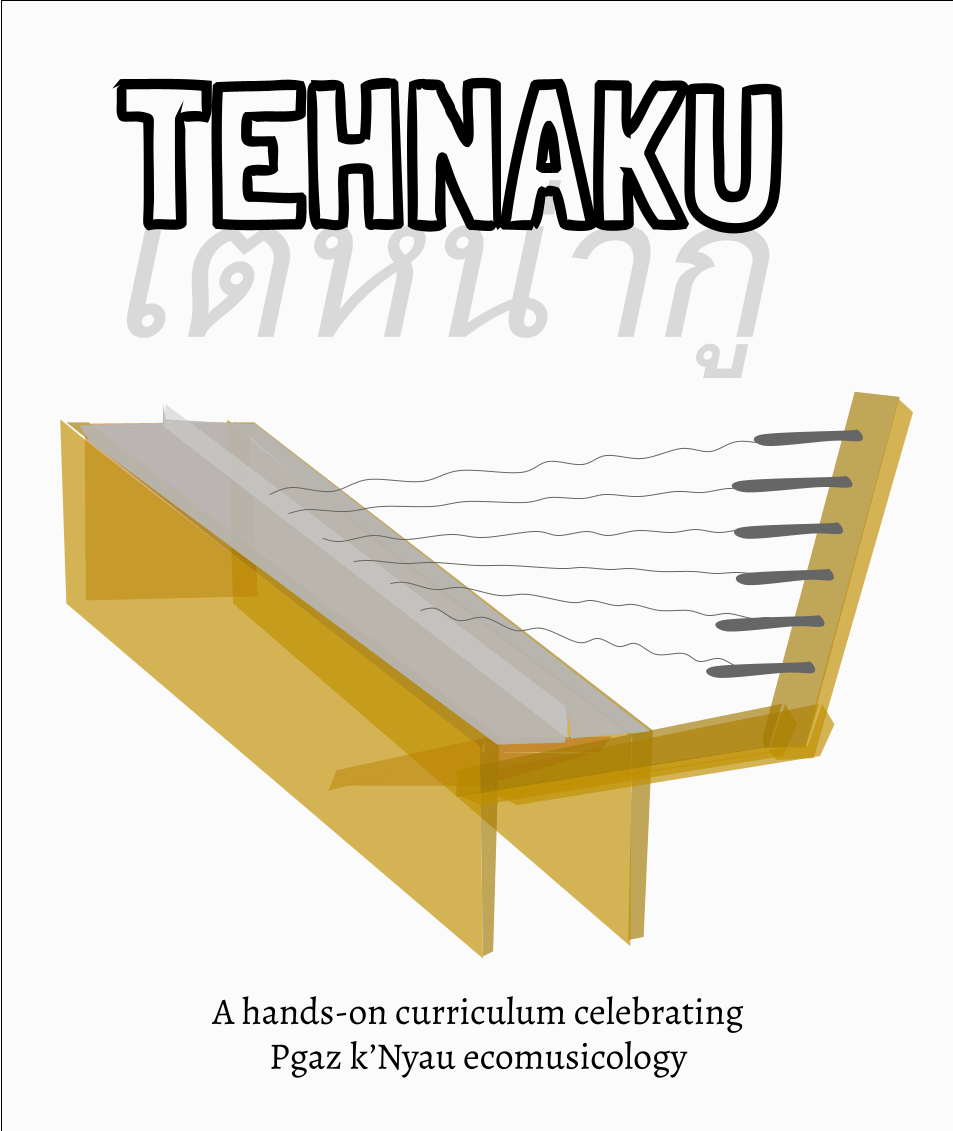
Our latest project is a co-authored book, The Orphan’s Harp, an illustrated children’s book version of the legend of the tehnaku passed on to Chi via oral tradition and translated to English for general audiences (in production and ETA 2027 with Picnic Heist Publishing).
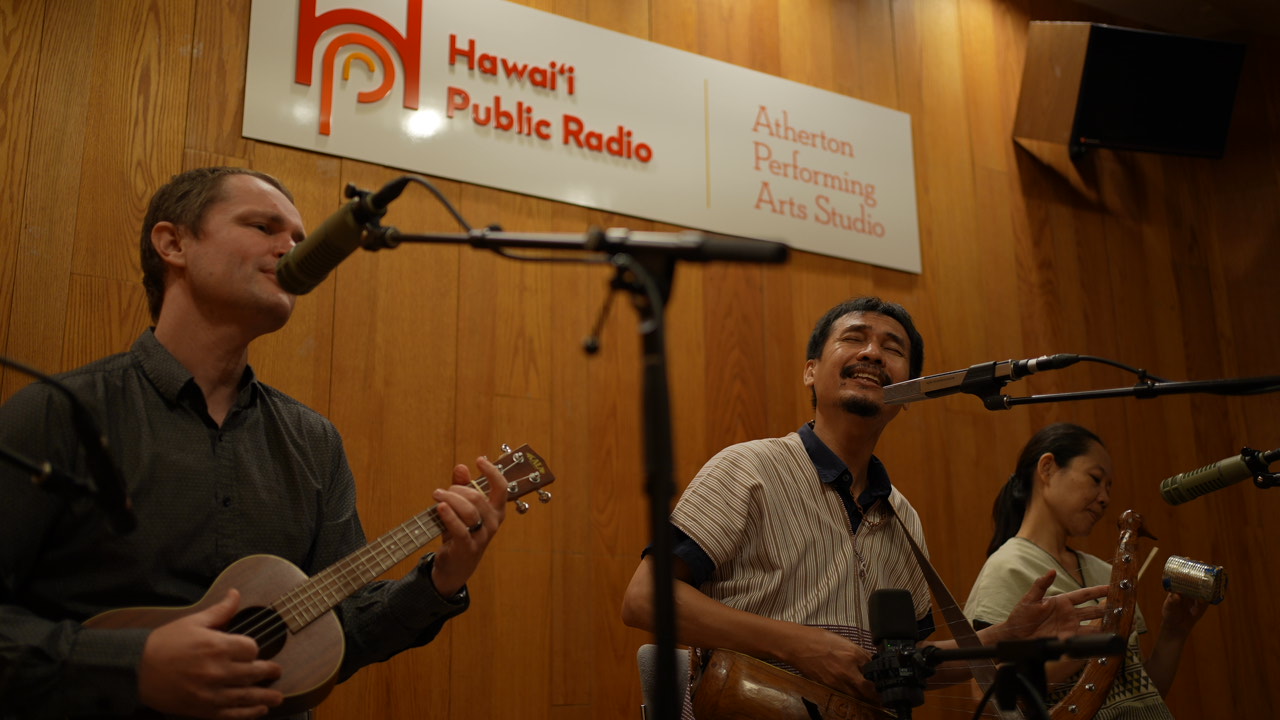
Wonderfully illustrated by Karese Kaw-Uh, The Orphan’s Harp will also be accompanied by a companion book offering additional cultural information. And, as much of the story is structured in the form of poetry based on (and including) traditional Pgaz k’nyau hta, Chi and I also collaborated on an accompanying studio album, recorded using home-made instruments from my MUS311 ensemble courses at the University of Hawai’i.
Instruments used in the album:


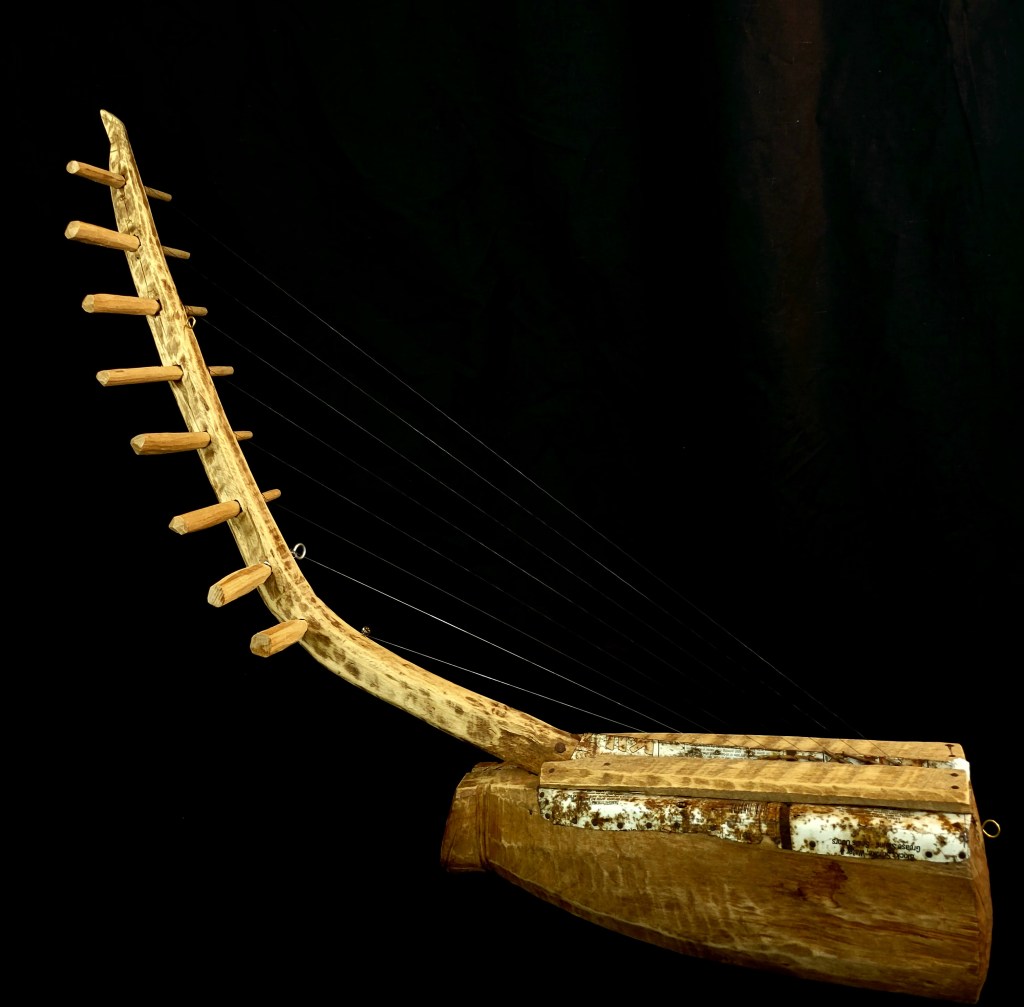



Accompanying Album:
Album program notes:
Tehna Re Re
Tehnà re re tehnà re,
Saw trù re re saw trù re
Tehna harps that twang and zing,
Sawtrù bamboo zithers sing.
De tòe se poe súe tòe se,
Súe tòe se poe de tòe se.
Oh, that we knew how to play,
songs would fill each night and day.
Pga de mè se súe mè se,
Sâw sòe yùe law í law e.
Some they say still play them well,
sounds that charm us as a spell.
This song, a traditiona hta, features a tehna made by students in my MUS478 course at UH (survey of music of Thailand), using bike brake cables and hardware store supplies. Vocals include Chi (original Pgaz k’nyau) as well as myself (English translation).
The song itself mentions two traditional instruments: the tehnaku (harp) and sawtru (2-string bowed bamboo zither). Knowledge of both instruments dwindled significantly with the modernization and missionization campaigns (both Christian and Buddhist) in the 20th century. While the tehnaku has made a significant comeback, the sawtru remains little known (hence the lyrics, “Oh, that we knew how to play….”)
For the melody, we took inspiration from the traditional tune Tue Pho uses to tell the story of Naw Mue Eh, หน่อหมื่อเอ.
Posts & Ghosts
Long ago on elders’ lands,
rice was sown and picked by hand;
Bamboo fencing kept the beasts,
off our treasure, out of reach;
After harvests we returned,
to the hearth where pickets burned;
In the forests left alone:
posts and ghosts and orphan’s home.
These song lyrics (newly composed based on the original text) seek to set the scene and differentiate the forest (a place for spirits) from the village (the dwelling of humans). Bamboo picket fences kept the animals out of the paddy. While the pickets were taken to the village after the harvest for fuel, the posts were left out in the fields. It was one of these posts that the orphan used to craft the first tehnaku. The melody of this song is inspired by Tue Pho’s “Tiger” song, หนุ่มไทเกอร์.
Hear Ye, Hear Ye (Wrist-tying Announcement)
Hear ye, hear ye, loyal fans,
I shall tell thee of my plans;
Land and Water Lords demand,
feasts for blessing of our land;
All shall gather, it must be,
grandmas, daughters, and….
The signalling instrument heard here is a bamboo slit drum called k’lo, which had many uses in traditional Pgaz k’Nyau villages. Various patterns communicated different messages and announcements (a slow and even pace announced a wedding feast, a pattern of five beats meant a funeral was being planned, and a pattern of three called for a community meeting to seek a resolution to a problem). The Town Lord uses this drum repeatedly in the story to call such meetings and make announcements.
Hear Ye, Hear Ye (Wake the girl)
Hear ye, hear ye, here’s the news!
This girl’s not allowed to snooze!
While she sleeps the spirits hide,
crops and streams shall wilt and die!
So with thee I make a pact:
he who wakes her from her nap,
shall be given half my wealth,
half my riches for himself,
Half my lands for growing rice,
and the girl to be his wife!
Dirty Orphan
If you do not make your bed,
your soul might escape your head.
Through the forest it will roam,
till it finds the orphan’s home.
Dumb and dirty, poor is he,
cannot write and cannot read.
Should he let your soul return,
it may come back soiled and burned.
A newly composed poem in the style of traditional hta to help convey the disdain the lowlanders held toward the Orphan and the fear of the forest. The tune is inspired by a classic Tue Pho song, เก่อเจ้าโอ้ด่อทีหล่อชู่.
Make a Tehna
Hollow like a boat she glides,
deerskin roof and teakwood sides.
Tehnà à pli loe jaw chûe;
De tòe múe de súe de súe.
From the leather shoots six lines,
toward the prow these twisting vines.
Tehnà a pli loe jaw chûe;
Pga de mè se kòe nà mùe.
Pluck the vines and strum the strings;
hear their voices sing and ring.
Yoe kòe de na sè kè ku;
Maw noe kòe sàw thàw kru kru.
Tehnaku, we’re plucking you;
may your voice sing out “kru kru.”
Another duet featuring Chi Suwichan, this song is set to the pedagogical piece, Naw Cha Tru, one of the first melodies taught to a new tehnaku student. We found this a fitting melodic setting of this hta in that it is said to be the first song ever composed for the tehnaku by the Orphan.
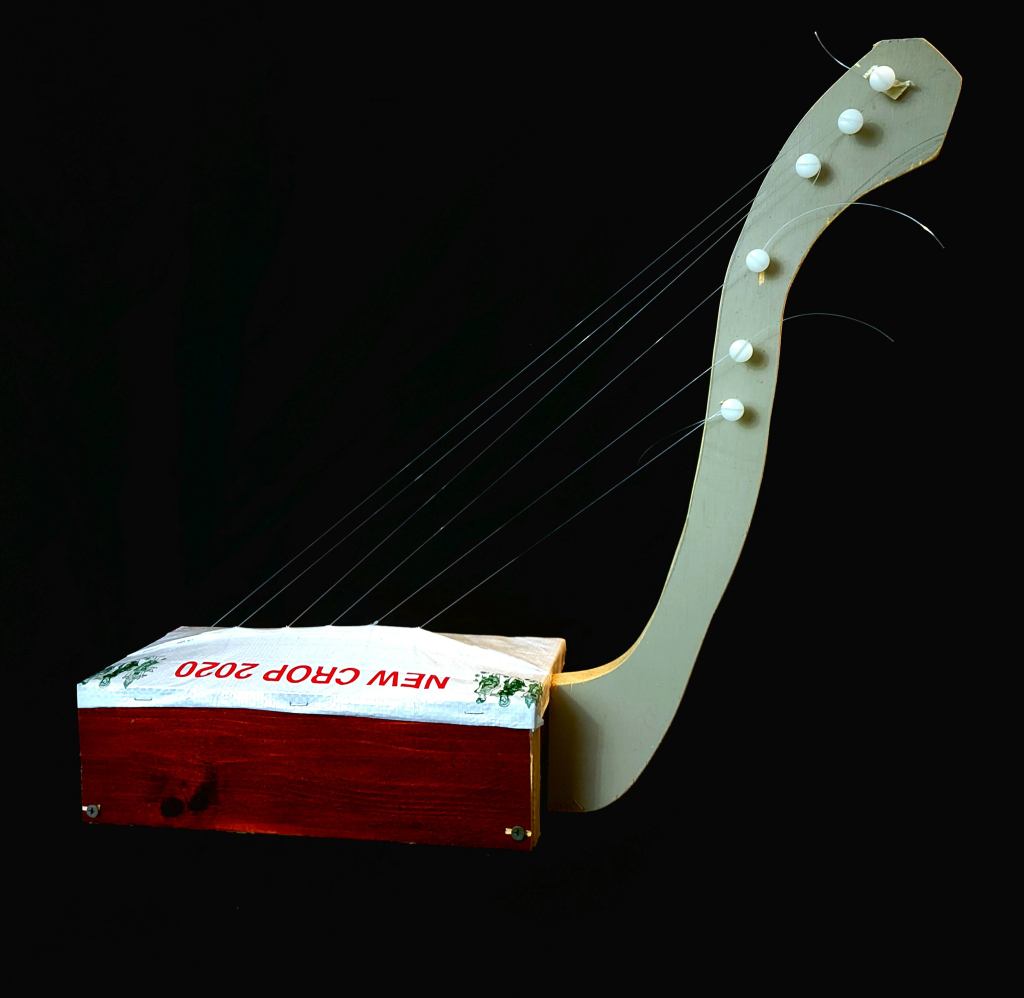
The traditional lyrics present the basic elements and materials of the instrument: teak wood, animal hide, rattan vines, and the voice of the instrument itself, said to sing out “Kru na na” or “kru kru” when plucked (potentially a reference to the sound of a dove). Heard on this track is a tehna made with fishing line, plastic bolt tuners, and a rice bag membrane.
700 Suitors
Yelly belly, loud and brash,
hoping to collect some cash;
Trots in braying like a horse,
screamed and lost his voice of course.
Brawny bugler brings a horn,
breathes in deep, preps to perform;
Blasts a blowing blaring beep,
lips foam fuzzy, flat, asleep.
Dullard drummer tromps up next,
thinking he’s prepared the best;
Booms his drum loud as a bomb,
breaks his drumstick then his palm.
Fooly footsie flops on up,
clomps with stomps and jerky jumps;
Leaping, lurching, limping, hops,
whining, waning, moaning, drops.
Pumped and plumpy, here’s a porter,
heaves and hauls a wooden mortar;
Shakes the house and cracks the frame,
daughter stirs but sleeps the same.
Grumpy, growling, town lord waits,
different suitors: same failed fate;
Shakes his head at each failed try,
Frowning, fretting, starts to cry.
This was my first home-made tehnaku (I used moped brake cables instead of bicycle cables, which are much thicker and required additional reinforcement for the instrument), and this tune is inspired by one of the most popular of Tue Pho’s songs, the luk-thung-influenced หนุ่มโนวา.
Helpless Lord
Helpless! See? My power wanes.
Gone the spirits, what remains?
Suitors stumped and bachelors beat,
fractured hands and broken feet.
Are there no more men around?
Can’t a hero still be found?
Mighty is my daughter’s will.
What?! My men point to the hills?
To the dirty orphan’s lair?
“Dear God! No!” becomes my prayer.
Still, what other choice have I?
Stand here stubborn while we die?
So I’ll send my men on out.
Bribe him, trick him, drag him down.
Though unworthy of my vote,
maybe he knows tricks we don’t.
Orphan’s Arrival
Pacing, racing, half past noon,
spirits’ feast commencing soon.
As the youngest daughter sleeps,
Mighty leader wails and weeps.
Hark! The hills are growing loud!
Orphan’s entrance draws a crowd.
They’re not cheering, no, that’s laughter.
Welcome now assured disaster.
From the dirty hills he brings:
Muck and yuck and rotten strings.
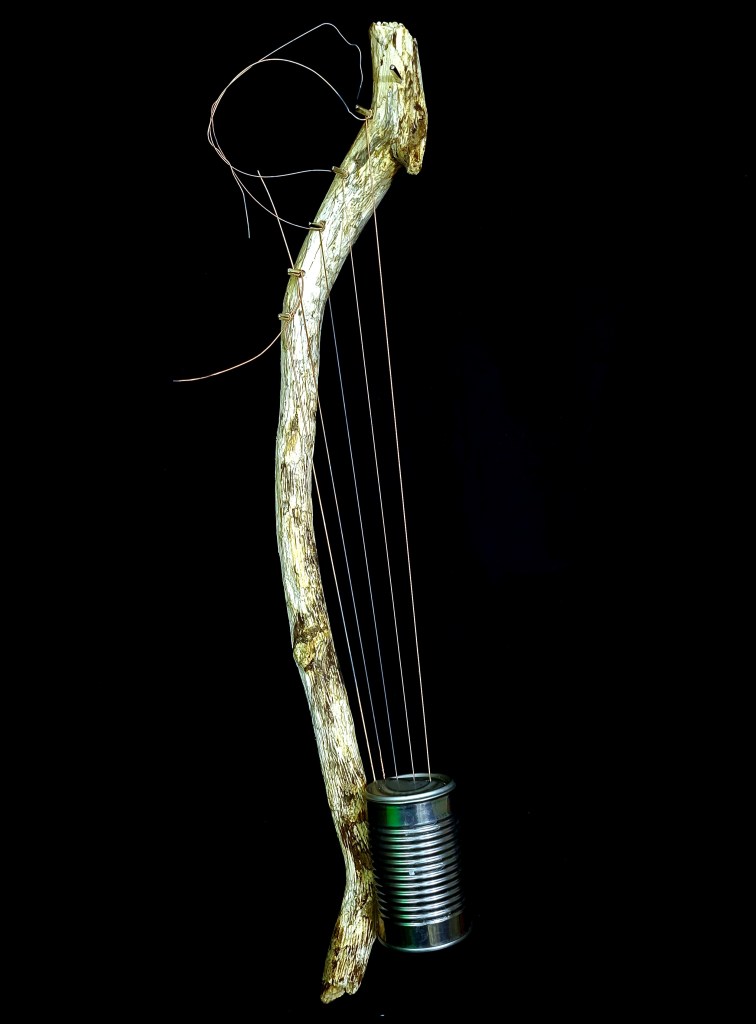
This tehnaku was built from beach-scavenged materials (soda can, driftwood, fishing line, and bamboo). As soon as I saw the shape of this piece of driftwood, I knew I had to use it to make a tehna.
Daughter’s Song
Is your father ruler of,
Land and water, skies above?
And what’s my utility?
Come at every beckoning.
Show my face and take the stage,
Be displayed and lead parades.
Every action that I take,
Any choice I’m forced to make,
Is evaluated by,
This all-seeing public eye.
Oh that I could slip away,
Far from crowds with judging gaze,
Far from gawking grudged glares,
Far from whispered words and stares.
Is there even such a place?
Such an isolated space?
Where frogs sing and slow their pace?
Where by nature I’m embraced?
Where might I find solitude,
True companionship, and food,
Free to be and free to choose?
Where my spirit thrives, renewed?
Oh, can anyone relate?
Oh, could any grant that fate?
Will I only ever be,
Prized by eyes allured by greed?
This newly composed song for this book was our attempt to add some nuance to the otherwise voiceless female protagonist in the story. In the original legend, we only hear others’ opinions of her (stubborn, beautiful, without any agency of her own). We wanted to explore her reasoning and examine why, when she was so adamant about not participating in the wrist-tying ceremony, she would go off with the orphan to the forest so willingly. What was the draw? She needed a voice and a choice, as she was more than a prize to be won. This song helps establish her motivations, the gift of nature, and the genuine bond in her relationship with the orphan. For the instrument, we opted to feature the sawtru (a bowed bamboo zither traditionally played by women, used to draw out and tame wild boar from the forest).
In the Woods
Khu law sè loe thi chà pu;
Khu law wà loe thi chà pu.
Sè de kè ke te-nà-ku;
Wà de kè ke te-nà-ku.
In the woods with streams and deer,
Spirits you’ve been taught to fear.
Vines that climb to reach the blue,
With them make a tehnaku.
De loe doe loe blaw nà hu;
De loe blaw loe doe nà hu.
Nàw tòe ka sá tòe nà hu;
Mi sòe pe à mò baw hu.
Play it in the forest and,
It resounds across the land,
Hear its fame throughout the world,
All will know…except one girl.
Another song from Chi’s pedagogical repertoire that all new learners should master, this traditional hta has been translated and is sung as a duo in the original Pgaz k’Nyau and English version. Lyrically it gives a sense of the obsession that can result from building a successful and functional instrument: once you start making your own instruments from locally available materials, you’ll start to notice the potentials all around you (wood, bamboo, rattan, fishing line? So many possibilities!)
The orphan plays this song in the story just out of view of the girl, and the curiosity becomes too much. Who could sit out the world premiere of this music? For this and the next song, Chi plays his tehnaku (notice the dove-shaped head?)
The Gathering
Daw pue wae bòe sà mè khu,
bàw thàw khaw lae thàw chu mu.
Daw pue wae bòe sà mè khu,
sè dò maw kàe thàw ta su,
If we just unite and meet,
Heaven’s doorstep we shall greet.
If our spirits gather now,
Bears may manifest from mounds.
Nàw doe jáw jáw doe nàw oe,
dì khlòe sà mi thò lae poe.
Nàw doe jáw jáw doe nàw oe,
dì khlòe sà mi thò lae wa
Boys and girls who know their roots,
They shall find the sweetest fruits.
Flocks that swoop in sync in flight,
They shall find the berries ripe.
Bàw wà mi phlàw thàw loe le,
à bàw blà à pgà a de,
à bàw blà à pgà a de,
gòe li mùe hae tòe law che
Bamboo shoots bent by the wind,
Safe, protected by their kin.
Young and old are intertwined,
Holding fast to ties that bind.
Another song from Chi’s pedagogical repertoire that all new learners are expected to master, this traditional hta celebrates the traditional animistic matrilineal gathering (all the women of a family contributed to a family spirit). It asserts the power of the gathered, inter-generational community: together we are stronger.
Hear Ye, Hear Ye (Town Lord’s Offer)
I, your lord, have made a vow,
half my land for thee to plow,
And my daughter’s hand to thee,
I contingently bequeath.
After three years doth go by,
should your wealth be less than mine,
Such shall prove your skill unfit,
and ye shall surrender it.
If you’re tired of making beds
If you’re tired of making beds,
You can come with us instead.
Our home waits to welcome you,
Lush and flush with solitude.
There we’ll hunt and camp and feast,
On the blessings nature brings.
Taro, rice, cucumbers, beans,
Pumpkins, roots, wild herbs, and greens.
We will work together there,
What we gather we will share.
Onward, upward. Hark!
They call: greetings from the waterfalls.
Rivers, roots, and leaves provide,
All that you’ve been long denied.
Spirits roam the forests here,
But they seek respect, not fear.
Many friends we’ve overlooked,
Nature is our golden book.
This song was recorded on a tehnaku brought back from Omkoi (where we lived for 3 years). You also can hear the loud croaking of rice paddy frogs underlying the song (a field recording from Mae Tuen Noi village). The melody is based on a Thai-Lao classical piece, ลาวดวงเดือน, and performed with a Lanna-Thai-inspired (salaw saw sueng) ensemble featuring a home-made ching, taphon drum, PVC pipe khlui, and the bamboo k’loh drum. We wanted to sonically represent the lowland group that gathered at the Orphan’s side. Thus, the first verse has the orphan’s invitation (solo voice and tehnaku); and in the second verse, the girl joins in on the k‘loh (Clack clack clack!) as he gains some followers (represented by the addition of lowland-inspired instruments).
Hear Ye, Hear Ye (Come and gather)
Come and gather, one and all,
Come and watch the orphan fall!
What’s he up to in those hills?
What’s his handiwork, his skills?
Have him bring his tasty treats,
I just may concede defeat,
If his foods can make me drool,
So much that it forms a pool,
And I swallow three times o’er,
I shall bow, face to the floor,
But if he should fail today,
He will pay and go away.
And resume his lonely life,
Without money, without wife.
Come and gather, strong and frail,
Come to see the orphan fail!
The town lord’s final announcement outlines the rules of the competition: if the orphan is so successful up there in the mountains, let him prove it! Let him set a feast, and if his foods are delicious enough to make the Lord drool (and swallow three times), the orphan will have proven his success. But if not, he loses all the wealth, people, wife, and land granted to him in the original contest.
Food Court
Roasted on a stove of brick,
smoky, salty, crisp drumstick.
Juices flowing, skin that crackles,
overheated lord just cackles.
How about a honeyed ham?
Braised and salted leg of lamb?
Pumpkin curried bamboo shoots?
Taro, turnip, earthy roots?
Lord gourmand just yawns and snores,
he has seen it all before.
Spicy deer with lychee curry?
Orphan’s fans are getting worried.
Chili paste with lemongrass?
Town lord’s double chin just laughs.
Baskets emptied, stocks depleted,
orphan lord might be defeated.
Then he narrows both his eyes,
calling up one last surprise,
From his bag, all twisted, tangled,
he reveals a wild green mango.
Town lord scoffing, laughing, coughing,
yellow teeth all gummed with toffee.
But that fruit’s sour citric acid
makes the glutton’s jaw hang flaccid.
Just imagining its sharpness,
cutting through the grease and darkness,
his defenses start to go,
and saliva starts to flow.
Look! He’s swallowed one big gulp!
As the orphan chews the pulp,
Orphan squeals with squishy face.
Oh how sour! Oh, what taste!
“That’s not fair! I want to try!”
Town lord chomps, then starts to cry.
Licking lips and so improper,
swallows two more gulps of slobber.
Silent, pensive, first he sighs,
then his lips lift toward the skies.
“Well played, Orphan! I’m impressed.
Look at me, a sloppy mess,
While I sought to make you pay,
you have shown the better way.
Hear ye, hear ye, we decree!
Every year a mango feast,
Brothers, sisters, daw pue wae,
what we gather, we shall share!”
This final showdown includes an epic battle of taste buds and wills, and the Orphan wins with grace.
The tehnaku constructed for this song points to food through the use of a soup can for its main resonating body. The curved branch was found on a hike in the mountains (as a nod to the earlier hta: Khu law sè loe thi chà pu, Sè de kè ke te-nà-ku, or “head to the headwaters and mountains, and if you see a curved branch, make a tehnaku”).
Melodically and thematically, the song is inspired by the classic Thai song ผู้ใหญ่ลี, which tells its own story of the rich lowland urbanite authorities’ encounter with the rural folk.
Hear Ye, Hear Ye (reprise)
Hear ye hear ye, we decree:
Every year a mango feast!
Brothers, sisters, dawpuewae:
Come on back. Ha-gke ha-gke
Bring your spirits, bring your food,
Bring your gifts, your gratitude.
Rivers roots and leaves provide
All that we’ve been long denied,
As one family we’ll abide
Spirits, siblings, strings are tied
To this land where we reside
Work together, side by side.
I was getting tired of this formulaic announcement by the end of the book and wanted to redeem it. In this final rendition, the k’loh is joined by the tehnaku and a 3-part harmony representing the gathering of the Town Lord, Orphan Lord, Daughter, and the whole community. What starts as the typical announcement becomes a mashup ending with a Karen new year song alluding to the Wa tah ka bamboo dance.
How to make a tehnaku (the hardware store version)
If this project or book has you inspired to play the instrument, it’s worth learning how to make one. Tue Pho makes his own in this คนค้นฅน documentary (Thai language skills required: Khon-Khon-Khon). The following tutorial shows you how to make your own using hardware-store materials (and bike brake cables):
Rehearsal Songs
Once you’ve built a tehnaku, you can learn to play with Chi Suwichan. Here’s four songs to get you started:
How to make a Tehnaku (Cardboard Version)
Don’t have access to highland forests or tools? You can make an office cubicle version of the tehna MUS311 style with these simple instructions and materials:
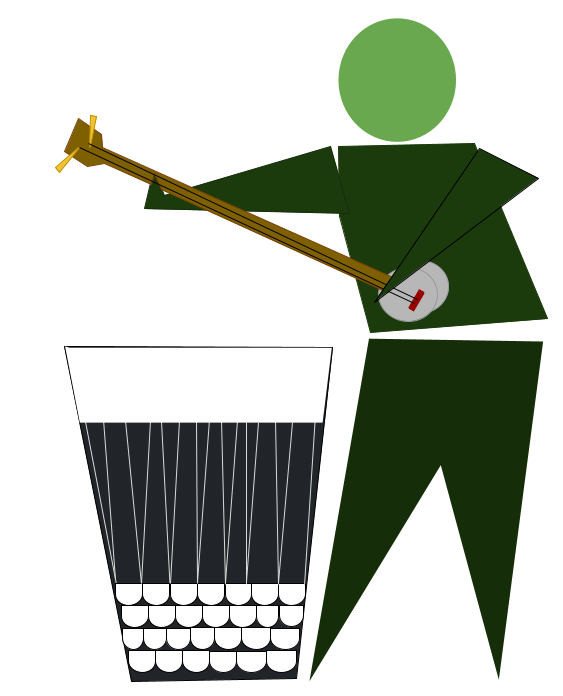
 Kani ka ʻōpala: music made from Rubbish